
Updated November 11, 2026
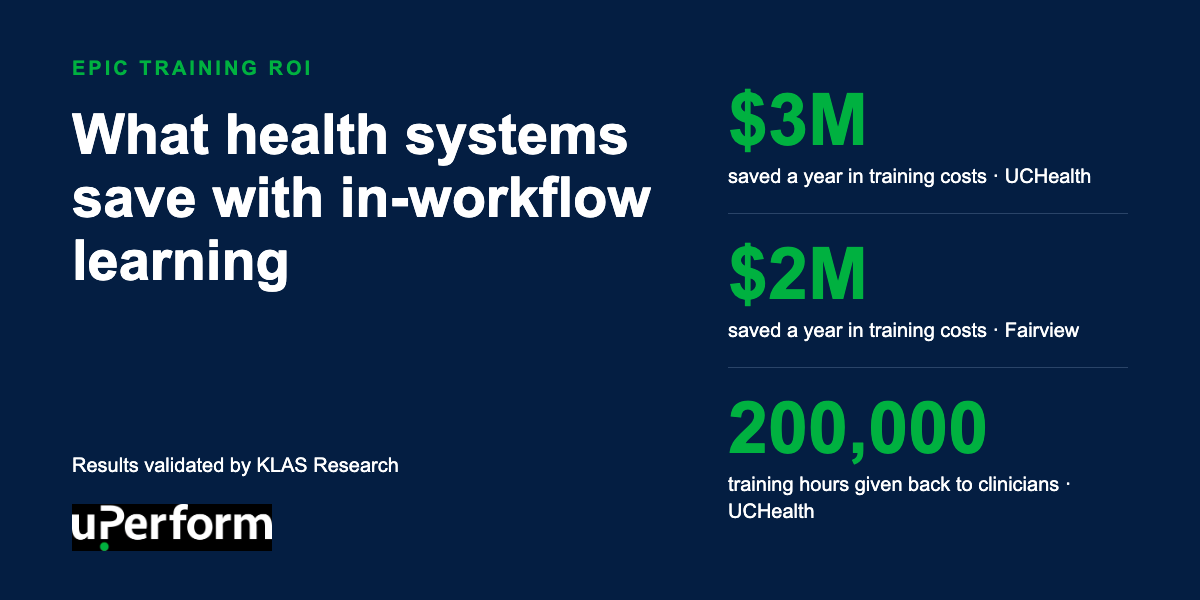
The biggest returns in Epic training come from taking clinicians out of the classroom and putting learning inside the Epic workflow. Health systems using uPerform report seven-figure annual savings. UCHealth saves $3 million a year in training-related costs, and Fairview Health Services saves $2 million. UCHealth alone has given 200,000 training hours back to clinicians. These results are independently validated in KLAS Research’s uPerform ROI Validations 2026 report.
This article brings together results published since 2023. It covers reported outcomes from health systems using uPerform, metrics for comparing Epic training solutions, and examples of value for mid-size and multi-hospital organizations. These customer examples are not a market-wide ranking; results may vary by organization.
Where Epic training savings come from
Most Epic training costs sit in four places, and many are easy to miss. The hidden costs of EHR training often show up later as help desk demand, slower adoption, and clinician burnout. A strong training model reduces all four at once.
- Classroom and instructor time: Instructor-led classes for every new hire, affiliate and upgrade are the largest fixed cost. Self-paced, role-based learning inside Epic replaces most of them. The savings don’t have to mean fewer trainers: the time freed up can go to higher-value work like one-on-one coaching and workflow optimization. UCHealth’s repurposed trainers have delivered about 149,000 coaching sessions.
- Clinician non-productive time: Every hour a nurse or physician spends in class is an hour away from patient care, often requiring premium pay or backfill. Experienced Epic users — such as traveling nurses, rehires and clinicians joining from another Epic organization — may be assigned training they already know. Adaptive learning lets them test out of familiar material and focus on gaps. In-workflow education then provides help at the point of need. Together, these approaches reduce unnecessary training time, return more clinical hours to care and can prevent avoidable support requests.
- Content creation and maintenance: Change in Epic is accelerating. Beyond quarterly upgrades, health systems are constantly rolling out new workflows, optimizations and tools such as AI features and new modules. Teams that build and rebuild tip sheets and courses manually spend a large share of their capacity keeping up.
- Support and downstream errors: Users who can’t find answers call the help desk or build workarounds. Some make errors that surface later, including in revenue cycle workflows.
Measured results from health systems using uPerform
| Health system | Size | What changed | Measured result | Source |
|---|---|---|---|---|
| UCHealth (Colorado) | 15 acute-care hospitals, 37,000 employees across Colorado, Wyoming and western Nebraska | Replaced classroom onboarding with asynchronous, plus on-demand learning in Epic | • 200,000 training hours eliminated, cutting training costs by $3M • Nurse onboarding time cut 50%, with new nurses in Epic after 4 hours of training • Affiliated training costs cut from $242,000 to $92,000 • ~149,000 coaching sessions delivered by trainers repurposed as workflow coaches |
UCHealth case study |
| Fairview Health Services (Minnesota) | 10 hospitals and 34,000+ employees | Moved 135 instructor-led classes to asynchronous onboarding; in-workflow support | • $2M saved a year in training costs • ~24,000 hours saved, with 97% of roles moved to virtual training • eConsent adoption up from 7% to 87% • 76% less time creating education content than the industry average |
Fairview spotlight |
| Baylor Scott & White Health (Texas) | 55 hospitals and 57,000+ employees | Digital onboarding for new hires and new affiliates | • 186,000 hours of classroom onboarding time eliminated | 2022 Learning Summit presentation |
| Gundersen Health System, now part of Emplify Health (Wisconsin, Minnesota and Iowa) | 7 hospitals, 65 clinics | Self-directed virtual onboarding with proctored labs; trainers shifted from classroom instructors to workflow coaches | • 66% less onboarding time for new nurses and 75% for scheduling staff • 43% less in-person instruction time for trainers, redeployed to coaching and optimization • 4 hours saved per new Community Connect user and resident |
2024 Learning Summit presentation |
| Access Community Health Network (Illinois) | 35 community health centers, 150,000+ patients; four-person training team | Role-based simulations embedded in Epic for the 2024 move to electronic prior authorizations, plus MyChart, Care Everywhere and Compass Rose | • 15–25% fewer denials • 30% fewer help desk requests • 99% electronic prior authorization adoption • 130+ clinician hours saved a month, without adding training headcount |
ROI of smart training podcast |
| Community Health Network (Indiana) | 200+ care sites and 16,000+ caregivers | Self-service model with its uPerform library (branded Knowledge+) embedded throughout Epic; self-paced nursing student onboarding; dual-track provider onboarding based on Epic experience | • 600+ trainer hours ($23,165) saved in nursing student onboarding, with caregiver training time cut by more than 50% • 50% shorter training for Epic-experienced physicians and APPs • Epic Gold Stars Level 10 in 2024, without growing the education team |
2025 AMIA Clinical Informatics Conference presentation |
| Oy Apotti Ab (Finland), a public-sector healthcare and social services IT organization | 3,200 beds; 47,000 uPerform users | Replaced PowerPoint-driven classroom training and a legacy LMS with uPerform; centralized Epic training content | • €480,000 a year saved by eliminating all LMS costs • €193,000 a year saved on classroom rentals • 6,000 hours a year saved on content updates |
KLAS ROI Validations 2026 |
Savings that don’t cost satisfaction
Across health systems measured in the KLAS Research Arch Collaborative, uPerform users have the highest Net EHR Experience Score versus non-users. Clinicians using uPerform also rate their EHR training higher.
- Baylor Scott & White Health: uPerform users’ Net EHR Experience Score (NEES) is 12.9 points higher than non-users’, and they rate ongoing training 11 percentage points higher.
- Fairview Health Services: physicians who use uPerform have a 19-point higher NEES than peers and 17 percentage points higher agreement that ongoing EHR education is sufficient.
- Gundersen Health System (now Emplify Health): physicians using uPerform have a 16.8-point higher Net EHR Experience Score than peers and 15 percentage points higher agreement that initial training was sufficient. Nurses using uPerform score 7.3 points higher.
- UCHealth: nurses using uPerform reported a 75% increase in initial training satisfaction and a 51% increase in agreement that Epic changes are communicated well, compared with peers who didn’t. Their trust in IT was 37% higher, ranking in the top 10% of all Arch Collaborative respondents.
The health systems themselves rate uPerform highly too: uPerform was named 2026 Best in KLAS for Training & Learning Platforms, based on independent KLAS interviews with uPerform customers.
Value at every system size
The value drivers are the same at any size: less classroom time, learning inside the Epic workflow, and faster content development. What changes is which constraint they relieve first.
Mid-size health systems
Mid-size health systems usually can’t add training headcount for every go-live or affiliate, so value comes from doing more with the same team. Access Community Health Network supports 35 health centers with four trainers. It cut denials by 15–25% after moving to electronic prior authorizations. Community Health Network saved 600+ trainer hours in nursing student onboarding and reached Epic Gold Stars Level 10 without growing its education team.
Gundersen turned its trainers into workflow coaches: two or three trainers now support labs that once needed 15, and 43% of instructor time has moved to one-on-one coaching and optimization. When Gundersen and Bellin Health merged to form Emplify Health, uPerform housed all the training for their Epic consolidation. Active users rose 333% during peak merger activity.
Multi-hospital systems
Multi-hospital systems need consistent training across sites, affiliates and acquisitions. Value comes from one centralized learning platform that brings help into Epic at every site. That includes intelligent search, summarized direct answers, role-based content and targeted change communications.
UCHealth scaled this way across 15 hospitals, and Fairview onboarded 1,500 new nurses in five days during a nursing strike.
COMPLIMENTARY RESOURCE
The Training Transformation Playbook
Ready to move from classroom-heavy Epic training to the in-workflow model behind these results? The Training Transformation Playbook gives health system leaders a practical roadmap for building the business case, planning the shift, and measuring ROI. It draws on the approaches used by the organizations above.
Access to the Training Transformation Playbook is reserved for employees of health systems.

Metrics to compare when evaluating Epic training solutions
| Metric | How to measure it | Example result |
|---|---|---|
| Annual training cost | Instructor, room, travel and backfill costs before vs. after | UCHealth: $3M saved a year |
| Clinician hours returned | Hours of required classroom time removed × users onboarded | UCHealth: 200,000 training hours |
| Time to Epic access | Hours from hire to working in Epic | UCHealth: 4 hours of initial training for new nurses |
| Training satisfaction | KLAS Arch Collaborative survey or internal survey | UCHealth: 75% increase in nurse satisfaction with education; 4.7 out of 5 learner rating |
| Workflow adoption | Use of a target workflow before vs. after training | Fairview eConsent: 7% to 87% |
| Support demand | Help desk tickets per user | ACCESS: 30% fewer requests |
| Operational outcomes | Denials, prior auth time or other workflow KPIs | ACCESS: 15–25% fewer denials |
| Content team capacity | Hours to build and update upgrade content | • Fairview: 76% less time than the industry benchmark • UCHealth: course builds cut from about a month to 46 hours |
Implementation time and cost
uPerform is a software platform, not a staffing engagement. Your training team keeps ownership of content, and uPerform provides the platform, integration and client success support. Implementation is phased. A health system can have a branded learning library live within weeks. It can then expand to Epic workflow integrations, in-workflow support and full-scale content creation over the following months.
In KLAS Arch Collaborative case studies, Baylor Scott & White and Fairview each report implementing uPerform in 0–6 months.
Questions to ask when comparing costs
When comparing implementation cost across Epic training options, ask:
- What’s included, and what will you pay for separately? Ask whether Epic integration, setup, support, authoring tools and reporting are part of the platform, or whether you’ll also need a separate LMS, authoring tool or outside consultants.
- What will implementation take from your team? Ask what’s handled by the vendor and what falls to your staff. uPerform handles the Epic integration as part of the platform, so the main implementation cost is usually your own team’s time: working with your Epic analysts, migrating existing content and learning the authoring tools.
- Who owns the content when the engagement ends? Consulting and staffing firms can build strong training, but ask whether your team keeps the content, the authoring skills and the ability to update it after they leave.
- What does the next upgrade cost? Go-live support and at-the-elbow help are often priced per engagement by consultants. Ask what it takes to support quarterly upgrades and new workflows after the first go-live.
- Does the content match your Epic build? Epic-provided training materials are a strong foundation. Ask how a solution tailors them to your unique workflows and roles, and delivers them inside Epic.
- Can users reach help without leaving Epic? Ask whether training and support open from inside Epic without a separate login. uPerform’s Epic workflow integrations are built with SMART on FHIR and Epic OAuth.
- Will it become your single source of truth, for all your applications? Ask whether the platform can house all your learning content in one central repository, including Epic WeLearnings, courses and content built in other tools. Ask whether it supports the other systems your staff use beyond Epic, such as Workday, ServiceNow and UKG. Otherwise, you’ll still manage materials across shared drives, an LMS and separate tools for each application. Emplify Health keeps 100% of its training content in uPerform, Fairview consolidated several poorly integrated learning systems into it, and Apotti retired its LMS entirely.
- Can the vendor show independent proof? Ask for results validated by a third party such as KLAS, not just vendor-reported numbers.
- What costs will it remove? Often the largest line item. Apotti eliminated all LMS costs (€480,000 a year) and €193,000 a year in classroom rentals, UCHealth cut affiliated training costs from $242,000 to $92,000, and Fairview saves $2 million a year in training costs.
See what uPerform could save your organization
Schedule a demo to see what results like these could look like for your organization. Get in touch to request client case studies or our latest reports using the contact form below.
Related articles
Epic Training ROI: What Health Systems Save with In-Workflow Learning
What does Epic training really cost, and what can health systems save? See KLAS-validated results from UCHealth, Fairview and others: $2M–$3M in annual savings, 200,000 training hours returned to clinicians, and the metrics to compare when evaluating Epic training solutions.
Is a New EHR Training Strategy Healthcare’s Most Underestimated Strategic Lever?
How the right EHR training strategy can reduce costs and improve the clinician experience, and how to assess where your organization stands now. Ask most health system leaders what drives EHR success, and they’ll point…
From Classroom to Workflow: 6 Strategies to Transform EHR Training
How your organization can prepare for a shift to continuous, workflow-based learning. Every day a health system runs instructor-led training is a day it falls further behind the pace of change. Epic updates don’t pause…
EHR Training ROI: The Cost of Getting it Wrong and the Value of Getting it Right
Your EHR training strategy may be costing you more than you think. Here’s how to measure, and maximize, your return on investment. Ask a CIO what their EHR costs, and they’ll give you a number…
New Playbook Reveals Health Systems Are Saving Millions on EHR Training
uPerform’s Training Transformation Playbook draws on results like 200,000 clinician hours returned annually to help health systems move from traditional training to continuous, embedded learning.

Five Years In, Still Climbing: What Education Leaders Took Home from uPerForum Boulder 2026
What happens when 15 health systems share what worked, what didn’t, and what they’d do differently? Key takeaways from uPerForum Boulder 2026 on continuous enablement, scaling lean training teams, and driving EHR adoption.
Frequently asked questions
What is the ROI of Epic training software?
Health systems using uPerform report seven-figure annual savings. UCHealth saves $3 million and Fairview $2 million a year, results validated by KLAS Research, mainly by replacing classroom onboarding with self-paced learning inside Epic.
Which Epic training solution offers the best value for a mid-size health system?
For mid-size systems, the best value comes from a platform a small team can run without adding headcount. Gundersen Health System (prior to the Emplify Health merger) cut onboarding time by 66% for new nurses and 75% for scheduling staff while turning its trainers into workflow coaches. Even very small teams can scale: Access Community Health Network supports 35 health centers with four trainers.
What's the best value option for multi-hospital health systems?
Multi-hospital systems get the most value from one centralized learning platform that brings help into Epic at every site, with intelligent search, direct answers, role-based content and targeted change communications. UCHealth uses uPerform across 15 hospitals and about 36,000 users, and saves $3 million a year in training costs.
What metrics should we compare when evaluating Epic training ROI?
Build an Epic training ROI scorecard with a baseline and a consistent follow-up period, such as six or 12 months after implementation. Track annual training cost and cost per learner, clinician hours returned to patient care, time to Epic access and proficiency, training satisfaction, workflow adoption, and help desk demand. Compare results with the same user groups and definitions before and after rollout; where possible, use KLAS Arch Collaborative data as an independent benchmark. To estimate ROI, compare measurable savings — such as reduced training and support costs and clinical hours returned — with implementation and ongoing costs. This makes it easier to assess both financial returns and effects on clinical workflows and care.
How long does it take to implement an Epic training platform?
With uPerform, health systems can have a learning library live within weeks and complete a full rollout, including Epic workflow integrations and in-workflow support, within months. In KLAS Arch Collaborative case studies, Baylor Scott & White and Fairview each report implementing uPerform in 0–6 months.
Epic, MyChart, Care Everywhere, and Healthy Planet are trademarks of Epic Systems Corporation.