
How your organization can prepare for a shift to continuous, workflow-based learning.
Every day a health system runs instructor-led training is a day it falls further behind the pace of change. Epic updates don’t pause for a training calendar. Staff turnover doesn’t wait for the next scheduled session. And clinicians who learned a workflow eighteen months ago at go-live are, in many cases, working from memory alone or creating workarounds on the fly.
That’s not a failure of training. It’s a fact of how adult learning works. No amount of front-loaded, instructor-led training was ever going to make months of feature and workflow changes stick as recallable memory, and it shouldn’t have to. Clinicians don’t need to memorize more. They need a reliable, evolving, workflow-embedded source of support so that the moment they hit something they don’t know, they can get the answer and move on, without breaking stride in the patient encounter in front of them.
Real training transformation means treating training as an ongoing part of the workflow, not a one-time event tied to go-live. Organizations that successfully make this shift don’t do it all at once. They identify areas of opportunity and layer meaningful change into their training strategy as time and resources allow. Don’t let the pursuit of a perfect plan stand in the way of progress: find one entry point and start there.
Based on industry research and real client experiences, here are six strategies you can begin putting into practice today to prepare your organization for an EHR training transformation.
Strategy 1: Establish a baseline and identify workflow friction
Of the six strategies here, this is the only one where sequence matters: establish your baseline first. Organizations that wait until after a rollout to look for evidence of impact have already lost their control group; there’s no clean before-and-after to point to. Once you’ve decided to begin your training transformation, establish a baseline before the first module goes live. Then, track it consistently on a fixed reporting cadence.
The baseline should do double duty: it’s also where friction surfaces. Spikes in help desk tickets, time spent in the EHR that doesn’t translate to throughput, and workflows clinicians quietly route around instead of through are usually visible in the data before anyone reports them out loud. You likely won’t transform your entire training strategy all at once. Establishing a baseline helps you determine where to focus your efforts early in your transformation.
While this list is not exhaustive, organizations should consider tracking things like clinician satisfaction, retention, time spent in the EHR, after-hours EHR use, adoption rates, throughput, and help desk utilization. This data helps organizations tailor their new training strategy to prioritize users’ most pressing needs and helps education teams report progress to leadership and earn buy-in.
Strategy 2: Establish scalable infrastructure
Scattered training content is the real starting point for many organizations: SharePoint folders, email attachments, a legacy LMS, third-party content, and virtual classroom recordings that don’t talk to each other and don’t live where clinicians can easily find them. Consolidating everything into a single source of truth is an important first step, but it’s only one facet of the infrastructure question. The larger goal is a platform that lives inside the clinician’s workflow, scales as your content library and organization grow, and can support every strategy that follows, from role-specific content to in-the-moment delivery, without bolting on a new system each time.
None of what is scattered today has to be thrown out and rebuilt from scratch. It has to be brought into one platform.
When Fairview Health Services began its journey, training materials were scattered across SharePoint, email, multiple learning management systems, and virtual classrooms. In December 2020, Fairview consolidated all of it into a single learning platform accessible directly inside Epic.
“The uPerform Learning Library gave us a central repository for all of our learning collateral, so with one click in Epic our users can get all of their learning materials from one central platform,” says Derek Harley, Learning Experience Design Leader at Fairview.
Consolidating materials into one central repository made it easier for Harley’s team to manage content and keep it up to date, while improving the accessibility and findability of training materials for its end users, and gave them a foundation to build the rest of their training transformation on.
Strategy 3: Deliver learning in the workflow, and promote it
Content that lives outside the workflow assumes clinicians will remember it exactly when they need it. In-workflow learning skips that assumption altogether, meeting clinicians exactly when and where they need it most: in-app guidance, embedded tip sheets, and short simulations accessible at the point of need consistently outperform anything delivered in advance.
When Fairview launched a new eConsent navigator workflow in Epic, adoption lagged. After embedding a microlearning video directly inside the new workflow, adoption jumped from 7% to 87%. That kind of shift rarely happens on its own, though. Even strong in-app content needs a push: identifying the specific feature or workflow with the biggest gap, building targeted and relevant content for it, and communicating why it matters, not just what changed, through the channels clinicians already use. Fairview treats this as a multi-channel effort: with uPerform Copilot Change Communications directly in Epic, while email, internal newsletters, and rounding carry the same guidance to clinicians outside of the EHR.
Strategy 4: Build modular, role-specific content
An initial rollout succeeds or stalls based on whether the content behind it is relevant to its users. Generic, one-size-fits-all material is the fastest way to lose early momentum: role, specialty, workflow, and experience level all change what counts as relevant, and clinicians disengage quickly from anything that doesn’t match their reality.
Data from KLAS Research repeatedly emphasizes the importance of workflow-specific training. In a 2024 study, clinicians who agreed their training was workflow specific were nearly twice as likely to be satisfied with the EHR’s functionality (71%) compared to those who disagreed (40%). Another study found that clinicians who strongly disagree that training was specific to their workflow are more than twice as likely to report planning to leave their organization.
Strategy 5: Align stakeholders and build long-term ownership
Training transformation works best with structured alignment across IT, clinical leadership, operations, and education, along with executive sponsorship that ties the initiative to the broader technology roadmap rather than treating it as a standalone support function. Just as important is content ownership: assigning responsibility by role, specialty, or workflow, with a defined review cycle, so materials stay accurate as systems change instead of quietly going stale.
Governance also must define the why, not just the what: understanding the reasoning behind a workflow configuration, not just the click-by-click steps, helps clinicians adapt faster the next time something changes. Treat alignment and ownership as a long-term investment you build alongside your training program, not a prerequisite that has to be in place before anything can move forward.
Strategy 6: Create a feedback loop
The data from Strategy 1 only tells half of the story. While it’s important, leading organizations also pair that data with direct input from post-training evaluations, pulse surveys, and the frontline super users who hear about friction long before it becomes a help desk ticket.
That input really starts to pay off when it runs back through the same governance structure Strategy 5 puts in place, not around it. Governance committees and content owners are the ones positioned to act on frontline feedback, since they already hold the review cycle and the authority to update materials. When that feedback is communicated back up to executive sponsors, it demands higher priority and support from leadership.
Feedback that never makes it back to clinicians, what changed and why, doesn’t build trust either. Closing the loop is what turns a one-way survey into a two-way relationship: clinicians see that their input shapes the training experience, which is what makes them willing to keep giving it.
What’s next for your training transformation journey
These six strategies reinforce each other, but you don’t have to tackle them in order or all at once. A cohesive learning platform gives you something to build on, the baseline tells you where to focus, delivering content in the workflow and building it around specific roles makes it stick, and long-term stakeholder alignment and feedback sustains the work over time. Start wherever your organization has the readiness and resources to move today, and don’t let the strategies you can’t tackle yet stand in the way of the ones you can. These six strategies are a foundation, not the complete picture.
Free Assessment
Download the Readiness Assessment Checklist
See where your organization stands today. Our Readiness Assessment Checklist walks through 13 yes/no questions across the same six areas covered above, then scores your answers to show whether you’re ready to build, ready to scale, or ready to lead.
The Training Transformation Playbook
Request the full Training Transformation Playbook
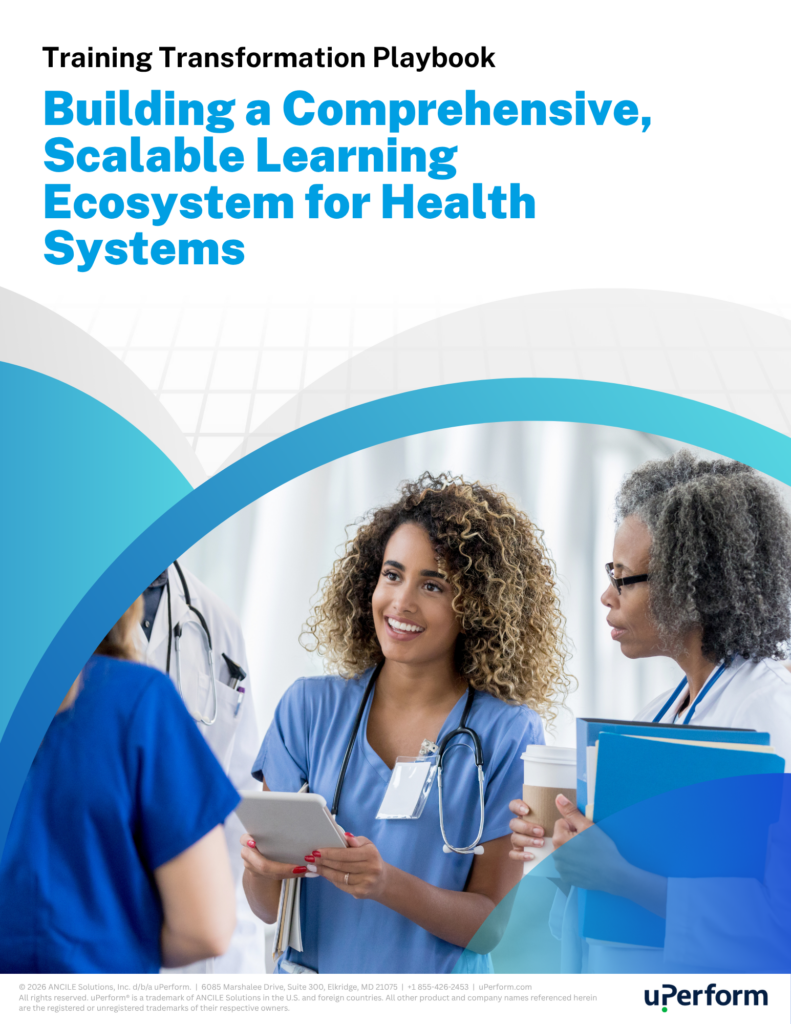
The Training Transformation Playbook is uPerform’s complete framework for turning training into a strategic capability, not an afterthought. It expands on the cost and ROI framework in this article with the full seven-step transformation model, governance structures, content and delivery strategy, super user programs, and measurement framework that leading health systems like UCHealth, Fairview, and others used to get these results. It’s built for CMIOs, VPs of Clinical Education, and Education Team Leads ready to move their organization from reactive to optimized.
Access to the Training Transformation Playbook is reserved for employees of health systems.
Frequently Asked Questions
What is workflow-embedded EHR training?
Workflow-embedded (or in-workflow) training delivers guidance, tip sheets, and short simulations directly inside the EHR at the moment a clinician needs them, rather than requiring them to recall a classroom session or search outside their workflow.
How do you transform EHR training from classroom-based to continuous learning?
Successful training transformations focus on six interconnected strategies: consolidating your educational infrastructure onto one cohesive learning platform, establishing a baseline and identifying friction, delivering content in the workflow and promoting it, building modular role-specific content, aligning stakeholders around long-term ownership, and creating a feedback loop back through governance. Organizations don’t need to tackle them in order; implementing what’s feasible now and building on it over time works just as well.
What metrics should health systems track before starting a training transformation?
Common baseline metrics include clinician satisfaction, retention, time spent in the EHR, after-hours EHR use, adoption rates, throughput, and help desk utilization, tracked before the first module goes live so there’s a clean before-and-after comparison.
Related Articles
EHR Training ROI: The Cost of Getting it Wrong and the Value of Getting it Right
Your EHR training strategy may be costing you more than you think. Here’s how to measure, and maximize, your return on investment. Ask a CIO what their EHR costs, and they’ll give you a number…
From Classroom to Workflow: 6 Strategies to Transform EHR Training
How your organization can prepare for a shift to continuous, workflow-based learning. Every day a health system runs instructor-led training is a day it falls further behind the pace of change. Epic updates don’t pause…
Is a New EHR Training Strategy Healthcare’s Most Underestimated Strategic Lever?
How the right EHR training strategy can reduce costs and improve the clinician experience, and how to assess where your organization stands now. Ask most health system leaders what drives EHR success, and they’ll point…