

Most NHS Trusts now have an EPR, but only 34% of staff say it makes them more efficient. Learn how a digital adoption platform delivers just-in-time, role-based learning inside the EPR, and how Apotti and Manchester University NHS Foundation Trust are already seeing results.
The NHS has made real progress on digitisation: around 91% of NHS Trusts in England now have an electronic patient record (EPR). But going live with an EPR is not the same as delivering value. The 2024 national EPR Usability Survey, run for NHS England by Ethical Healthcare Consulting and KLAS Research, heard from more than 23,000 staff. Only 34% said their EPR made them more efficient. Only 38% of clinicians and 42% of nurses find it easy to learn. And 48% of clinicians spend three or more hours a week on unproductive charting.
The BMA estimates that inadequate IT costs doctors in England more than 13.5 million hours a year, the equivalent of almost 8,000 full-time doctors. For Trust leaders, the challenge now is helping clinicians use the EPR confidently, accurately and efficiently, through every upgrade and for every new starter. A digital adoption platform (DAP) is one of the most practical ways to do that.
Key takeaways:
- Around 91% of NHS Trusts in England have an EPR, but only 34% of staff say it makes them more efficient (2024 national EPR Usability Survey).
- 44% of clinical staff receive no ongoing EPR training, yet 60% of clinicians and 70% of nurses want more.
- A digital adoption platform delivers just-in-time, role-based learning inside the EPR, available on any shift.
- Apotti saves around 6,000 hours a year on training content and €480,000 a year in LMS licensing (KLAS Research, 2026).
Why isn’t go-live EPR training enough?
Most Trusts still rely on classroom sessions before go-live, a few weeks of at-the-elbow support and a library of PDFs. That model struggles to keep pace with system upgrades, rotations and new starters, and clinicians are asking for more. In the same survey, 60% of clinicians and 70% of nurses said they want more EPR training, yet 44% of clinical staff receive no ongoing training at all.
KLAS Research has long found that training is one of the strongest levers on clinician experience. How clinicians rate their initial training explains nearly 50% of the variation in their EPR satisfaction, and KLAS recommends at least three hours of follow-up education every year. The Royal College of Physicians adds that systems are safer and easier to use where staff receive ongoing training and at-the-shoulder support.
What is a digital adoption platform and how does it close the gap?
A digital adoption platform (DAP) is software that delivers learning inside the applications staff already use. Instead of leaving the EPR to search for guidance, clinicians get the right support at the moment they need it:
- Just-in-time learning: Tip sheets, simulations and short videos at the point of need help staff complete tasks correctly the first time, reducing errors.
- Self-paced learning: Role-based pathways get new starters, rotating doctors and bank staff up to speed faster, and confident in the workflows that matter to their role.
- On-demand access: Self-paced content, available around the clock, fits around 24/7 shift patterns so staff can learn when it suits them without being taken away from patient care.
- Targeted updates: Role-specific guidance for upgrades and new workflows, plus analytics that show where staff struggle.
uPerform is a digital learning platform purpose-built for healthcare. It delivers this kind of in-workflow learning across Epic, other EPRs, and the wider technology ecosystem.
What are the benefits of a digital adoption platform for NHS Trusts?
For NHS Trusts, the benefits go well beyond cost:
- Usability: Staff learn by doing, in the live system.
- Efficiency: Less time searching for help and less time on unproductive charting.
- Accuracy: Standardised guidance supports consistent, safe documentation.
- Satisfaction: Ongoing support reduces frustration and helps retain staff.
- Value for public money: Less classroom, venue and content-maintenance overhead, freeing capacity to reinvest in patient care.
How are healthcare organisations using uPerform?
Apotti: modernising learning in a public-sector system
Apotti, a publicly funded healthcare and social services IT organisation in Finland, adopted uPerform to centralise Epic training content and reduce its reliance on classroom training. A 2026 KLAS ROI Validation Report found that since moving away from PowerPoint-driven training and a legacy LMS, Apotti has:
- Saved around 6,000 hours a year creating and maintaining training content
- Reduced in-person training resources by 2.5 FTEs through virtual training
- Saved €193,000 a year in facility costs and €480,000 a year by eliminating LMS licensing
- Reduced its vendor portfolio and third-party spending
- Improved clinician satisfaction
Self-paced learning is also building readiness for major change. Ahead of the first transfer of client records to Finland’s national social welfare data repository in 2026, social welfare professionals completed more than 19,000 online courses in just three months. Apotti calculated that this feat would have taken 18 months with traditional instructor-led training. Trainees also accessed courses at every hour of the day, which shows why 24/7 availability matters.
Manchester University NHS Foundation Trust: 500+ clinicians trained on ambient voice technology
Manchester University NHS Foundation Trust (MFT) created a uPerform Learning Pathway and digital learning course to train more than 500 clinicians on ambient voice technology (AVT) in five months. That pace would not have been possible with the Trust’s previous training model. The same approach will help MFT scale to more than 10,000 AVT users.
UCHealth: more confident, more efficient nurses
In a 2024 KLAS Arch Collaborative case study, UCHealth nurses using uPerform reported a 75% increase in satisfaction with initial training, a 27% increase in self-reported efficiency and a 28% increase in agreement that Epic enhances their clinical practice.
From go-live to everyday confidence
The next phase of NHS digital transformation hinges on supporting the people who use the technology every day. A DAP with in-workflow learning gives clinicians continuous, accessible support from their first login through every upgrade, new application and optimisation. It reduces frustration and helps Trusts get full value from a major public investment.
Book a demo to discover how uPerform can support your Trust’s EPR optimisation, or come and meet us at Ethical Healthcare’s National EPR Usability Summit on Wednesday 4 November 2026 in London.
Talk to an Expert
Get More From Your EPR Investment
Book time with our healthcare learning experts to see where your Trust’s current EPR training model is costing time and money, find the quickest wins for clinician confidence, and plan an approach that scales through every upgrade and new starter.
Frequently asked questions
What is a digital adoption platform in healthcare?
A digital adoption platform (DAP) delivers learning and guidance inside the clinical applications staff already use, such as the EPR. Instead of leaving the system to find a PDF or attend a class, clinicians access tip sheets, simulations and short videos at the moment they need them, in the flow of work.
Why do NHS Trusts need ongoing EPR training after go-live?
Upgrades, new workflows, rotations and new starters keep resetting the learning curve. In the 2024 national EPR Usability Survey, 44% of clinical staff said they receive no ongoing training. KLAS Research recommends at least three hours of follow-up education every year.
How does in-workflow learning fit around NHS shift patterns?
Self-paced content is available 24/7, so staff can learn during quieter moments on any shift instead of being released for classroom sessions. When Apotti moved to self-paced learning, it found trainees accessing courses at every hour of the day.
Can a digital adoption platform reduce EPR training costs?
Yes. According to a 2026 KLAS ROI Validation Report, Apotti saves around €193,000 a year in facility costs and €480,000 a year in LMS licensing, along with around 6,000 hours a year in content creation and maintenance.
COMPLIMENTARY RESOURCE
The Training Transformation Playbook
A practical guide for healthcare leaders who want to move beyond go-live training. Learn how leading organisations are building continuous, role-based learning programmes that cut costs, improve clinician confidence and keep pace with every upgrade.
Access to the Training Transformation Playbook is reserved for employees of health systems.
Related Articles
HETT Panel Discussion: Maximising your EPR investment
As the NHS makes strides toward digital maturity, many Trusts are running into similar capacity challenges. Training teams are struggling to keep up with the demand from a constant cycle of onboarding and training for…

HTN Panel Discussion: How to engage and develop a digital workforce and digital skills
This article is available courtesy of Health Tech News. You can view the original article on their website here. Our latest panel discussion focused on strategies for empowering a digital workforce, and how to develop…
NHS staff shortages: How self-directed onboarding can help Trusts maintain quality of patient care
As NHS staffing strikes continue to make headlines, Trusts continue to struggle with staff shortages that threaten patient care. The strikes add to what was already an overburdened and understaffed healthcare system. As of September…

HETT Show 2023: Addressing EPR education challenges with virtual training
Liz Griffith uPerform Director, EHR Education Welcome to the uPerform Thought Leader series, a collection of articles penned by industry leaders committed to improving health IT training and sharing their knowledge. Liz Griffith serves as…
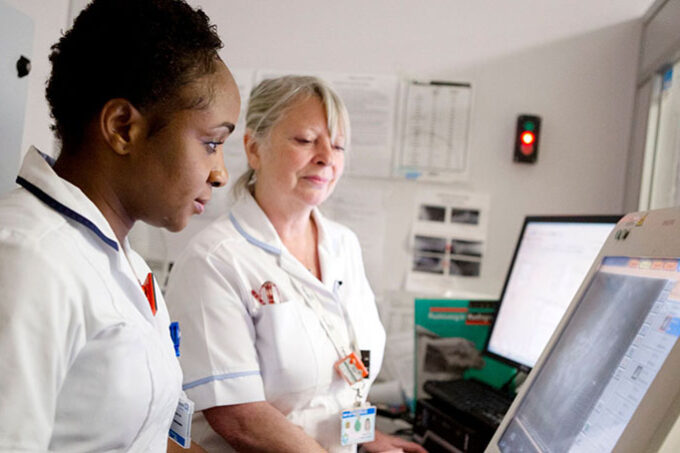
Stabilising and optimising the EPR for NHS trusts
As part of the U.K.’s digital transformation mandate, many NHS trusts are preparing for, or have already completed, their first EPR implementation. The EPR is a valuable tool for improving clinician efficiency and patient care.…

Preparing for the NHS EPR and digital transformation mandate
The NHS has been on a quest for digitisation since former British Secretary of State for Health and Social Care, Sajid Javid, set a target in 2022 for 90% of trusts to have an EPR.…