

Updated October 2026
Looking for ways to get new hires through Epic onboarding faster? Health systems are moving Epic onboarding out of the classroom and into self-paced, role-based training that new hires can start before day one. As a result, leading organizations now give new hires Epic access in hours instead of days. uPerform’s new hire onboarding platform supports this shift, and below we look at how UCHealth, Fairview Health Services, Emplify Health, and others have made it work. For the full picture of Epic learning, see our Epic training guide.
Key takeaways
- Self-paced, role-based Epic onboarding gets new hires into Epic in hours instead of days.
- UCHealth new hires can access Epic after as little as three hours of training.
- Emplify Health cut onboarding time 66% for new nurses and 75% for new scheduling staff.
- Experienced Epic users shouldn’t repeat training they’ve already mastered.
- Onboarding works best when it’s followed by ongoing, in-workflow support.
What is Epic onboarding?
Epic onboarding is the initial training new hires complete before they get access to their organization’s Epic environment. It teaches the workflows, build, and policies specific to that organization and role. Even clinicians with years of Epic experience usually need onboarding at a new organization, because every health system’s Epic build is different.
Traditionally, Epic onboarding has meant classroom sessions of 4 to 16 hours, with one role trained at a time. Today, more health systems are delivering it through self-paced, virtual courses and simulations instead.
How long does Epic onboarding take?
It depends on the role and the approach. Classroom onboarding often takes one to several days, and new hires sometimes wait days just to get a seat in class. With a self-paced, role-based approach, onboarding can be much shorter:
- UCHealth: new hires can access Epic after as little as three hours of self-paced training; for nurses, initial onboarding is a four-hour virtual course.
- Emplify Health: asynchronous onboarding cut training time 66% for new nursing staff and 75% for new scheduling staff. Some scheduling roles went from three or four days of training to one.
- Fairview Health Services: onboarded 1,500 nurses in five days during a nursing strike.
Why health systems are moving Epic onboarding to self-paced training
Many health systems struggle to scale classroom onboarding. As turnover rises and margins shrink, training teams have to do more with the same resources. A virtual, self-directed approach helps in three ways.
First, it saves new hires’ time. New hires work through role-specific courses at their own pace, so they skip irrelevant material and don’t wait for a classroom seat. In fact, many can start before their first day.
Second, it frees up trainers. Trainers build a course once and deliver it to every new hire. Instead of repeating lectures, they can focus on one-on-one coaching and EHR personalization.
Third, it improves satisfaction and efficiency. A 2023 KLAS Research study found that self-directed eLearning saved clinicians more time per week in the EHR than any other training method: an average of 91 minutes a week, compared with 72 minutes for one-on-one training and 33 minutes for classroom training.
How leading health systems run Epic onboarding with uPerform
UCHealth: Epic access in as little as three hours
As UCHealth grew from one hospital to a multi-state system, it needed a scalable way to onboard Epic users. Today, all Epic education for its roughly 32,000 Epic users is created and delivered virtually through uPerform.
“Then we have the uPerform self-paced learning [in Epic], which can be up to three hours. At the end of which, here’s your login. Go start taking care of patients. So, in as quick as about two hours, you’ve gone from ‘I need to get trained’ to ‘I can start taking care of patients.’”
– Dr. CT Lin, Professor of Medicine, University of Colorado Anschutz School of Medicine (former CMIO, UCHealth)

Onboarding doesn’t stop there, however. New hires continue with a 7-, 30-, 60-, and 90-day cadence of follow-up learning, and nurses can take more than 25 nursing-specific courses. As a result, UCHealth cut nurse onboarding time in half, and nurses reported a 75% increase in satisfaction with the self-paced format. Read the UCHealth case study.
Emplify Health: Onboarding that scaled through a merger
Before its merger with Bellin Health, Gundersen Health System, now part of Emplify Health, needed to onboard a growing number of new hires and affiliates without adding trainers. So the team built self-paced courses and simulations that new hires complete in proctored labs, where trainers answer questions as they come up.
“We found a great deal of efficiency with folks, because instead of having 15 trainers in 10 computer labs, we instead could have 2 or 3 trainers in different computer labs with many roles in those rooms taking the courses.”
– Bethany Poellinger, Senior Epic Instructional Designer

The result: onboarding time fell 66% for new nursing staff and 75% for new scheduling staff, and trainers spent 43% less time in siloed instruction. During the merger, the same model scaled to Bellin users. Read how Emplify Health scaled EHR training.
Fairview Health Services: 100% of roles on self-paced onboarding
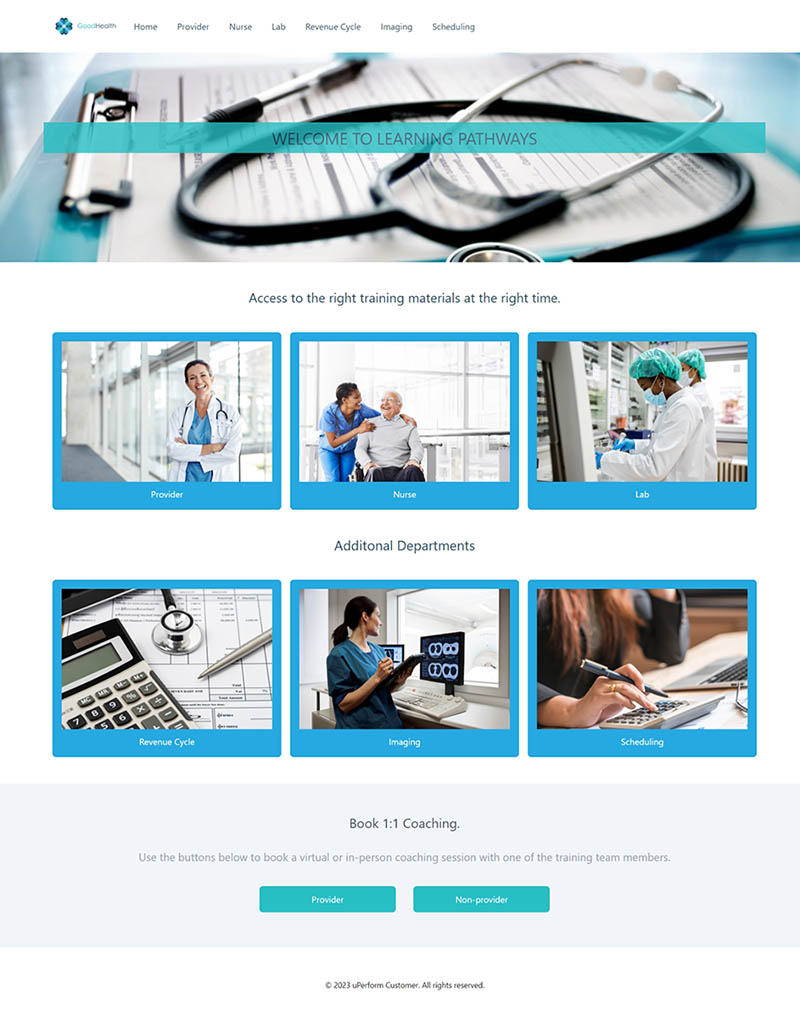
When Fairview Health Services faced one of the largest nursing strikes in the nation, its training team used uPerform Learning Pathways to build a combined course for 18 nurse learning paths. They onboarded 1,500 nurses in five days, and received “some of the best compliments on training that we’ve ever received from onboarding nurses,” according to Derek Harley, Learning Experience Design Leader.
With Learning Pathways, training teams can create unique learning tracks, or pathways, to guide users through Epic training courses based on user role, location, specialty, project or use case. With clearly defined pathways available on demand, learners can easily find and complete relevant courses and assessments.
Since then, Fairview has moved 100% of roles to self-paced onboarding, eliminating 24,000 onboarding hours and saving $2 million a year. Learn more in Faster, Better, Cheaper.
Aspirus Health: Interactive onboarding with measurable proficiency
Aspirus Health rebuilt its new hire onboarding around interactive eLearning, with courses cascaded over a new hire’s first months. New nurse hires achieved 96% proficiency on post-training assessments, and nurses spent less time in Epic during their first two months on the job. Read Stepping outside the classroom.
Don’t make experienced Epic users repeat onboarding
Not every new hire starts from zero. In fact, many clinicians arrive with years of Epic experience from another organization, so much of standard onboarding is review for them.
For example, Community Health Network found that half its incoming physicians and APPs already had significant Epic experience. So it launched a dual-track program: providers with six or more months of Epic experience in their role take self-paced eLearning, while everyone else attends instructor-led training. As a result, training time dropped 50% for Epic-experienced providers.
uPerform now makes this kind of personalization easier with Course Pre-Assessments and Progression Gating. With pre-assessments, learners show what they already know before a course begins and can test out of the lessons they don’t need. Meanwhile, progression gating requires learners to complete content before they move on, so training teams can confirm readiness.
Build your Epic onboarding curriculum faster
Moving to self-paced onboarding doesn’t mean building every course from scratch. The uPerform Starter Course Framework for Epic provides ready-made self-directed course templates for Epic Foundations and select Epic modules, covering clinical, provider, access, revenue cycle, and ancillary roles. Your authors then finalize the templates to match your build and workflows.
After onboarding: Support new hires in the workflow
Even the best onboarding can’t cover everything, and new hires forget what they don’t use right away. That’s why ongoing support matters as much as initial training.
With uPerform for Epic, clinicians can find courses, tip sheets, and simulations directly in their Epic workflow, whenever they need them. For example, uPerform users at Baylor Scott & White Health rate their Net EHR Experience Score 12.9 points higher than non-users.
Related Articles


Epic onboarding FAQ
How long does Epic onboarding take?
It varies by role and approach. Classroom onboarding often takes one to several days. With self-paced, role-based training, UCHealth new hires can access Epic after as little as three hours, and Emplify Health cut onboarding time 66% for new nurses.
Do experienced Epic users need onboarding at a new organization?
Usually, yes, because every organization’s Epic build and workflows differ. However, they don’t need to repeat material they’ve already mastered. Pre-assessments or experience-based tracks let them focus on what’s different.
Can Epic onboarding start before a new hire's first day?
Yes. With self-paced courses and simulations, new hires can begin learning their workflows before day one and arrive ready to get their Epic login.
Is virtual Epic onboarding as effective as classroom training?
In a 2023 KLAS Research study, self-directed eLearning saved clinicians more EHR time per week than classroom or one-on-one training. Aspirus Health’s new nurse hires achieved 96% proficiency on post-training assessments with interactive eLearning.
Who creates Epic onboarding content?
Usually an organization’s own Epic training or education team, because content needs to match the organization’s build. Tools like uPerform let trainers record a workflow once and turn it into courses, simulations, tip sheets, and videos.
Get new hires ready faster with uPerform
uPerform helps health systems deliver self-paced, role-based Epic onboarding, confirm readiness, and support new hires in the workflow long after day one. See how uPerform supports new hire onboarding, or contact us to schedule a demo.