
Healthcare doesn’t have a “go-live” anymore.
That was the opening provocation at uPerform’s Industry Partner Session at AMIA Amplify 2026 in Denver — and it landed. For years, health systems structured clinician education around a singular moment: months of preparation, days of training, flip the switch. But today’s clinical informatics leaders face something different: a constant stream of EHR updates, workflow changes, and new functionality, layered on top of already demanding clinical workloads.
The session, moderated by uPerform CMO Dr. Stephanie Lahr, brought together two CMIOs with hard-won experience rethinking EHR training at scale: Dr. Bryan Jarabek of Fairview Health Services and Dr. David Chestek of UI Health. Here are the highlights.
Key takeaways:
- Traditional, event-based EHR training doesn’t scale in a world of continuous change
- Create a training ecosystem that supports the full learning continuum, from onboarding, new go-lives, in-workflow support, and beyond
- Just-in-time, in-workflow support drives adoption better than classroom preparation
- Short-form content and creative engagement strategies outperform 8-hour virtual sessions
- Measuring behavior change — not just completion rates — is what validates your program
The EHR Training Engagement Problem — And What Actually Works
Dr. Chestek opened with a story that made the room laugh — and probably cringe in recognition. A colleague shared a photo of one learner’s COVID-era virtual, instructor-led training setup: a video game on one screen, EHR training on the other.
The lesson isn’t that clinicians are disengaged. It’s that we built training disengaging enough to compete with a video game — and lost.
The answer isn’t more training. It’s better-designed training. Fairview ran a March Madness-style competition where clinicians voted on the most useful EHR tips week by week. The winning tips, including smart phrases, preference lists, in-basket quick actions, turned out to also be the most genuinely useful. The internal buzz drove more clicks, more learning, and higher adoption.
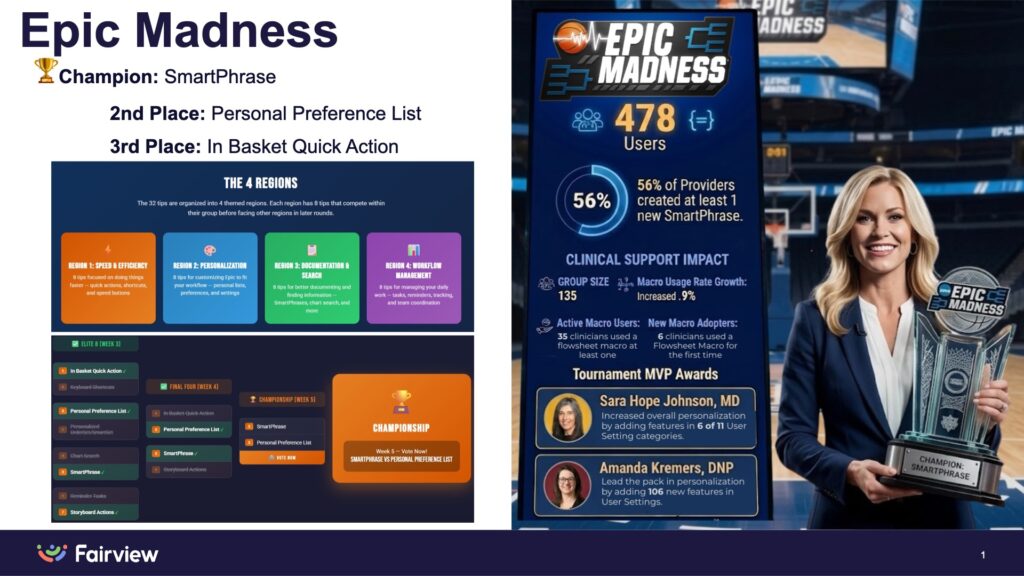
A slide from uPerform’s Industry Partner Session at AMIA Amplify 2026 showcases Fairview’s Epic Madness tournament environment.
This kind of consumer-inspired approach to clinician education is part of a broader philosophy Fairview’s education team has been building at Fairview for years — one he explored in depth earlier this year on the Becker’s Healthcare Podcast. That sustained investment has yielded measurable results: Fairview has eliminated 24,000 onboarding hours annually and saves $2M in training costs each year by shifting to asynchronous, workflow-embedded learning.
Just-in-Time Learning: Put the Road Signs on the Road
One of the most transferable EHR training best practices from the session: stop expecting clinicians to remember training from a month ago. Meet them where they are, when they need it.
It’s a principle fellow uPerform advisor, Dr. CT Lin, CMIO at UCHealth, has been championing for years — he called it “putting road signs on the road, not in the garage” at uPerform’s 2023 AMIA panel on just-in-time EHR training. Three years later, the same recommendation surfaces: don’t count on people remembering training; put it where they’ll see it when they need it most.
Fairview’s Chief Clinical & Nursing Informatics Officer, Anne LaFlamme, DNP, RN has put this philosophy into practice across their entire Epic training strategy — including for their eConsent rollout, where embedding a short instructional video directly in the workflow lifted adoption from 7% to 87%. Her nine tips for building a virtual Epic training program are worth a read for any informatics leader rethinking how learning gets delivered at scale. This approach is also the core idea behind uPerform’s in-workflow delivery — embedding role-specific guidance directly inside the EHR, so support is always available at the moment of need. Fairview clinicians who actively use those resources report Net EHR Experience Scores 19 points higher than non-users, per a case study published by KLAS Research.
Microlearning Beats Marathons: Format Matters
Dr. Chestek also debuted a format worth stealing: a fun microlearning video where “informatics Dr. Chestek” explains Epic’s new AI features to “clinical Dr. Chestek.” Short, punchy, watchable — the kind of content clinicians might actually choose to watch.
The broader point: clinicians are consumers. They’ve been conditioned by years of short-form video to expect concise, relevant content. TikTok-length microlearning wins over virtual classrooms every time — not just in engagement, but in retention and application.
90-Day Action Plan for Informatics Leaders
The session closed with a practical challenge: What’s one thing you could realistically start or strengthen in the next 90 days?
Three starting points from the discussion:
- Embed one piece of training at the point of friction. Find the workflow where clinicians are most likely to get stuck after a recent update. Put a two-minute video right there.
- Replace one classroom session with a short-form alternative. Pilot a microlearning video or a tip competition. Measure whether engagement improves.
- Redefine what “working” looks like. Completion rates are a proxy. The real signals are behavioral: Are clinicians using the new workflow? Are support tickets dropping?
The conversation at AMIA reinforced what uPerform hears from health systems every day: the organizations making progress aren’t the ones with the biggest training teams. They’re the ones that have stopped treating EHR education as a one-time event and started treating it as an ongoing strategy.
Related Articles

Epic Secure Chat Rollout: How Baptist Health Jacksonville Drove Adoption
A people-first change management approach turned a high-stakes communication platform switch into a model for EHR adoption When Baptist Health Jacksonville replaced its legacy communication platform with Epic Secure Chat, the rollout wasn’t just a…

Where to Find Epic Training for End Users
Epic training for end users is primarily delivered through healthcare organizations with limited options available online or without system access. This guide is for individual Epic users, job seekers, and healthcare professionals looking to learn…

New Epic Gold Stars requirements and how to earn them
Epic® shared new requirements for its Gold Stars program at its UGM event in August. The program initially focused on whether organizations were live with certain Epic applications and functionality. Now, the leading EHR will…

Epic Training for Health Systems: A Complete and Scalable Guide
This guide is for health systems and organizations responsible for training staff on Epic. Looking for Epic training as an individual user? Read our article Where to find Epic training for end users. Epic training is…

Epic onboarding with uPerform
Looking for ways to get new hires through Epic onboarding faster? As resource-strapped health systems race to onboard an influx of new hires, learning applications like uPerform offer a streamlined solution for creating and delivering…

Optimizing Epic Learning Home Dashboards with uPerform
Many health systems are leveraging Learning Home Dashboards to deliver a better Epic® training experience to users. While they can be a great way to improve access to important content and communications, managing numerous Learning Home…
How to create Epic tip sheets with uPerform
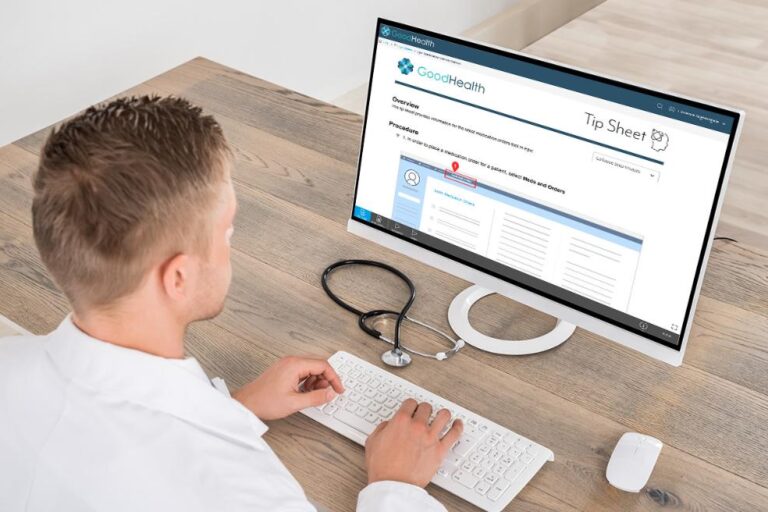
Epic tip sheets are a great way to help users through workflows and tasks in Epic Systems EHR software. Whether a user is performing a task for the first time or needs a quick refresher,…

Epic training for nurses: how to scale amid rising staff shortages
As hospitals and healthcare systems search for ways to combat the rising costs of the nursing workforce shortage, one key area to focus on is improving Epic® training for nurses. Comprehensive Epic training drives proficiency,…
Preparing staff for the transition to Epic Hyperdrive
Epic® Hyperdrive is here, and most health systems have already made the transition. Epic’s new web-based client is expected to improve user experience, add client deployment flexibility and simplify Epic upgrades. If you have…

Integration Guide: Epic in-app training with uPerform
Take your Epic® software training to the next level with learning in the flow of work. uPerform is a just-in-time training and support platform that provides users with customized Epic in-app training materials. With multiple…
PODCAST: 9 Tips for transitioning to a virtual Epic training strategy from Anne LaFlamme, CNIO at M Health Fairview
This is one chapter in Fairview’s ongoing story. Since this post was published, Fairview has gone on to transition 100% of staff to asynchronous onboarding and save $2M annually in training costs. See the full…
Interested in how uPerform supports just-in-time EHR training and in-workflow learning? Let’s talk.
FAQS
What are EHR training best practices for large health systems?
Leading organizations are moving away from one-time, classroom-based sessions toward asynchronous, continuous learning embedded in the workflow. Key practices include just-in-time support at the point of friction, short-form microlearning content, role-based delivery, and measuring behavioral outcomes rather than completion rates.
What is just-in-time EHR training?
Just-in-time EHR training delivers learning support directly in the workflow, at the moment a clinician needs it — rather than in advance during a classroom or eLearning session. Examples include embedded video links in the EHR navigator, or in-application tip sheets triggered at specific workflow steps.
How do you measure the effectiveness of EHR training?
Beyond completion rates, effective EHR training programs track behavioral signals: EHR workflow adoption rates, reduction in help desk tickets, clinician satisfaction scores, and time-on-task metrics. Organizations at the leading edge are also tying education outcomes to broader quality and efficiency measures.